Single target pulse properties
Single target pulse properties are output when an export of single targets from a region or a selection is performed on a single targets echogram.
The following table details when each pulse property is applicable and available from the different types of single target echograms supported in Echoview.
See: Single target analysis variables for definitions of the variables.
|
Pulse property |
single target detection - single beam |
single target detection - split beam |
single target detection - dual beam |
Simrad single target E telegrams |
HTI .RAW single target echograms |
Precision Acoustic Systems .ts4 single target echograms |
|
Y |
Y |
Y |
Always 6dB |
N |
N |
|
|
Y |
Y |
Y |
N |
N |
N |
|
|
N |
Y |
N |
N |
N |
N |
|
|
Y |
Y |
Y |
N |
Y |
Y |
|
|
Y |
Y |
Y |
N |
Y |
N |
|
|
Y |
Y |
Y |
N |
Y |
N |
|
|
Y |
Y |
Y |
N |
N |
N |
|
|
Y |
Y |
Y |
N |
N |
N |
|
When pulse properties are not applicable or available the no data value of -9.90E+37 is output.
Pulse properties defined
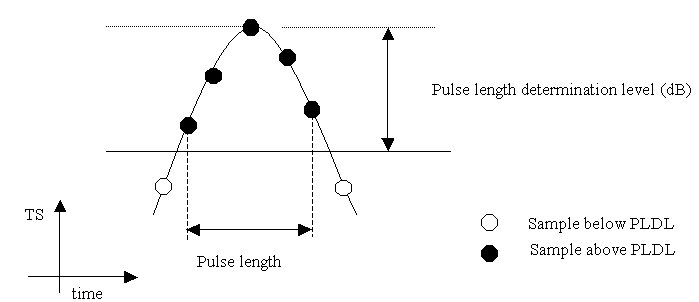
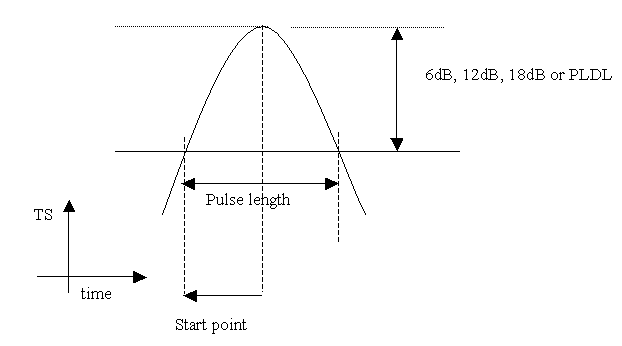
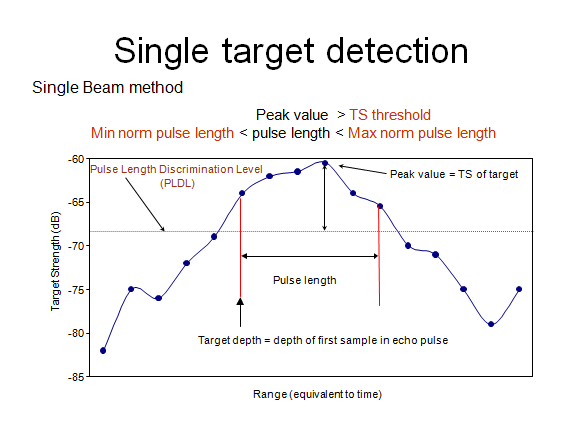
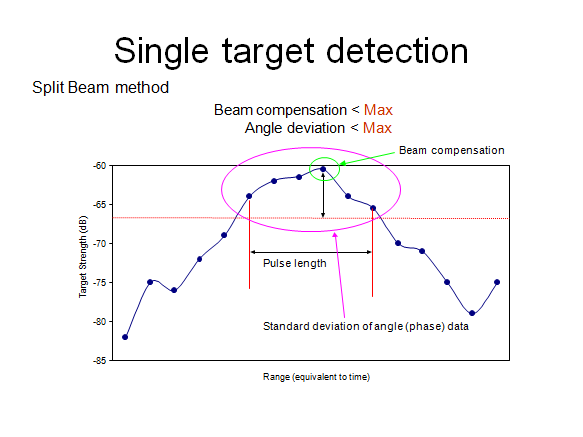
The diagrams below describe the pulse properties.
- Pulse Length Determination Level
- Pulse start and Pulse length
- Normalized pulse lengths
- Example of a single target pulse
Pulse Length Determination Level
Pulse Length and Pulse Start
Normalized pulse length
Single target pulse properties in Echoview are normalized to c*τ/2.
Where:
τ = pulse duration (s)
c = speed of sound (m/s)
The following is the rationale for dividing by the factor of 2:
A transmitted pulse leaves the transducer, reflects from an object in the water column and travels back to the transducer. The pulse duration and speed of sound are known and the time of the received echo at the transducer (TimeOfReceivedEcho) is measured.
The distance in the water column that a transmitted pulse travels to an object is c * TimeToObject.
The distance in the water column that an echo travels from the object to the transducer is c* TimeFromObject.
Echosounders measure the time of a received echo, which is a round-trip time i.e. TimeOfReceivedEcho = TimeToObject + TimeFromObject. An echogram (range mode) or ping graph displays ping sample data at the calculated distance from the transducer.
The range from the transducer to an object is calculated using the TimeOfReceivedEcho and the speed of sound.
RangeOfObject = c* TimeOfReceivedEcho/2
As a result, given a transmitted pulse with a duration of τ, the pulse occupies a distance of c*τ in the water column and in the range domain the distance is c*τ/2.
Note: Normalized pulse length can be used to filter detected single targets. The filtering can exclude false single targets and remove noise spikes.
Example of a single target pulse
|
|
See also
About Single target detection
Single target detection algorithms