Single target detection - split beam (method 2) algorithm
This operator applies a superset of the Single beam (method 2) algorithm adding available angle data and beam compensation estimates to the peak selection criteria.
See Single target pulse properties for illustrations on how target TS and normalized pulse lengths are determined. The page also offers an illustration of a single target pulse with respect to single beam detection settings.
Refer to Single Target detection algorithms for information about the method that best suits your data.
Variable properties
The first operand must be a TS variable.
The second operand must be an angular position, complex angular position or pulse compressed complex angular position variable; it is left to you to select the angular position data that corresponds to the selected TS data.
The following Single Target detection settings are used in the algorithm (which is a superset of the single beam (method 2) algorithm, additions being indicated in orange.):
|
Parameter |
Unit |
Allowed range |
Default value |
|
TS threshold (see note) |
dB re 1m2 |
-120 to 20 |
-50 |
|
Pulse length determination level (PLDL) |
dB re 1W |
0.01 to 30 |
6 |
|
Minimum normalized pulse length |
- |
0.01 to 10 |
0.7 |
|
Maximum normalized pulse length |
- |
0.01 to 10 |
1.5 |
|
Beam compensation model |
Simrad LOBE |
Simrad LOBE |
|
|
Maximum beam compensation |
dB re 1m2 |
0 to 35 |
4.0 |
|
Maximum standard deviation of minor-axis angles |
degrees |
0 to 45 |
0.6 |
|
Maximum standard deviation of major-axis angles |
degrees |
0 to 45 |
0.6 |
See Beam compensation for details on the Beam compensation models.
The maximum standard deviation settings for minor-axis and major-axis angles are expressed in mechanical degrees.
*HTI beam compensation offers additional settings, refer to HTI split-beam beam compensation for more information.
The single target detection parameters are set on the Single Target Detection page of the Variable Properties dialog box. Lines can also be selected for excluding targets above or below a line. Apart from limiting the target detection range, exclusions will also speed up processing, since less data will then be screened for single targets.
Notes:
- You should also check the effects of Calibration settings.
- The operator removes TVG and TvgRangeCorrection before target detection and re-adds TVG and TvgRangeCorrection once targets are detected. The TvgRangeCorrection equation is specified on the Calibration page of the operator. It is initially inherited from the Calibration page of the operand TS variable.
- In Method 2 operators, the TS threshold is applied to TS data after the targets are detected. So with the split-beam (method 2) operator the threshold applies to the compensated TS.
- The default value for PLDL is correct by convention and theory. It is not independent of other settings, and it is not normally changed.
- The operator uses the EffectivePulseDuration for normalized pulse length associated with PLDL list calculations for Simrad EK80 CW data.
- See also Using a SoundSpeedProfile: Notes
Algorithm
The algorithm is a superset of the single beam (method 2) algorithm. Additions are indicated in orange.
The algorithm acts on power data on a ping by ping basis. It calculates power data from TS values using the following formula:

Where:
TSi = target strength of sample i
Ri = the corrected range of the TS sample at Ri (m) from the transducer.
The corrected range equation is specified by the method for TvgRangeCorrection on the Calibration page of the Variable Properties dialog box for the TS variable.
α = absorption coefficient (dB/m)
The algorithm begins by removing data for which no targets need to be determined (i.e. data above and below the exclusions lines) and then processes the data in two main phases:
Phase I: Determine all power peaks that may indicate single targets
In the first stage the algorithm detects all peak values that could indicate the presence of a single target. In order for a power value to be retained as a peak value it must satisfy following peak selection criteria. The criteria are applied in this order, and only samples that pass one criterion are considered in the next.
Peak selection criteria
- The power value must be a local maximum. If the local maximum consists of more than one sample with the same power value, then the first sample in this sequence is used.
- The beam compensation value must not exceed the Maximum beam compensation (see Beam compensation).
- The pulse length (n)must be between the set limits, Minimum normalized pulse length and Maximum normalized pulse length (see below).
- The standard deviation of the angles (minor and major axis) of all samples within the pulse envelope must not exceed the Maximum standard deviation of angles allowed (see below)
Pulse envelope determination
The pulse length is determined as the distance between the first and last samples within the pulse envelope. The envelope consists of all samples surrounding the peak sample (p)which are above (peak power - Pulse length determination level).
The pulse length (for the peak selection criteria) is determined as the distance between the first sample (m)and last samples within the pulse envelope.
The standard deviation of the angles within the envelope is calculated for the minor-axis and major-axis angles independently as follows:
Let αi be the n angles under consideration. The standard deviation is:
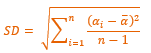
Where:
is the mean of αi.
Phase II: reject overlapping pulses
Based on the set of peaks obtained in phase I, single targets are determined as follows:
- Pulses are screened in order, from low to high depth ranges.
- The target range is calculated as:
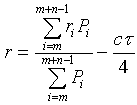
Note: the term cτ/4 is the equivalent of applying a SimradEx60 TvgRangeCorrection. For TS data derived from power measurements you can also apply this correction to the TS operand directly (on the Calibration page of the Variable Properties dialog box) but you should avoid applying it twice (in the operand and the choice of operator - the method 1 operators do not apply it). If your TS data already has a TVG range correction applied to it, and you know (or can calculate) what it is, you can remove it with this operator (via the Calibration page of the operator).
- The target TS value is calculated as:
TS_uncomp = Pp + 40log(r) + 2αr
- The target compensated TS value is calculated for the selected Beam compensation model as:
TS_comp = TS_uncomp + Corr - If the target compensated TS value is less than the TS minimum threshold, the target is rejected.
- If two target pulses overlap, the one with the lowest TS value is rejected.
Where:
n = pulse length
m = first sample in the pulse envelope
p = peak sample in the pulse envelope
ri = uncorrected range of sample i
r = corrected range of single target (see above)
Pi = power at sample i (see above)
Pp = power at peak sample in envelope
c = sound speed (m/s)
τ = pulse duration (s)
α = absorption coefficient (dB/m)
TS_uncomp = Uncompensated TS of the target
TS_comp = Compensated TS of the target
Corr = TS_uncomp corrected by the selected Beam compensation model.
Simrad split-beam compensation model (TS_comp = TS_uncomp + CorrSimradSplitBeam)
BioSonics split-beam compensation model (TS_comp = TS_uncomp + CorrBiosonicsSplitBeam)
HTI split-beam compensation model (TS_comp = TS_uncomp + CorrHTISplitBeam)
Single target properties
The table below describes how algorithm specific single target properties are calculated. See About analysis variables for a complete list of single target properties
|
Analysis variable |
Unit |
Description |
|
TS_uncomp |
dB re 1m2 |
Uncompensated TS of a single target. See step 3 of Phase II: Reject overlapping pulses (above) |
| TS_comp | dB re 1m2 |
Compensated TS of a single target. Compensation is calculated using the selected Beam Compensation Model. See step 6 of Phase II: Reject overlapping pulses (above) |
|
Target-range |
m |
Range of a single target. See step 2 of Phase II: Reject overlapping pulses (above) |
|
Angle-minor axis |
degrees |
Minor-axis angle of the peak sample |
|
Angle-major axis |
degrees |
Major-axis angle of the peak sample |
Notes
- There is no limit on the number of possible target detections in a single ping than theoretically possible with the given number of samples.
- The number of targets detected by the Single beam (method 2) operator will always be greater than or equal to the number of targets detected by the Split beam (method 2) operator. This is because the Split beam (method 2) operator employs the same algorithm above, but the pulses must pass angle criteria as well before being accepted.
- If you are comparing results with Simrad E telegrams please see Echoview and Simrad algorithms.
See also
About Single target detection
Single target detection algorithms
Echoview and Simrad algorithms
References
Simrad and Echoview single target detection terminology
Single target pulse properties