About 3D schools detection
Echoview can detect schools or large targets in multibeam data obtained during cruise scanning, instrument scanning, target-locked scanning, or by-ping detection. Multibeam school detection configurations store reusable sets of detection settings for different data or analysis requirements. Configuration settings are edited in the Multibeam School Detection Configuration Properties dialog box.
The resulting schools or targets can be viewed as 3D regions in scenes and multibeam echograms. The properties of 3D objects can be displayed on screen and exported for further analysis.
Four algorithms are available for 3D school detection. Their applicability depends on the scanning mode and how the data are to be processed:
- Cruise scanning algorithm
- Instrument scanning algorithm
- Target-locked scanning algorithm
- By ping algorithm
See About school detection algorithms for a summary of their availability and applicability. Research on scanning modes and school detection algorithms may also be of interest.
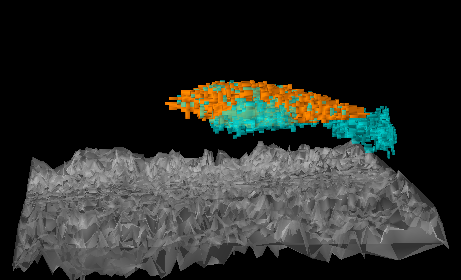
In the following example, two schools are displayed with the seafloor. Both schools were detected from the same data using different multibeam school detection configurations. The blue school, detected using less restrictive settings, is partially transparent so that the orange school, detected using more restrictive settings, is visible within it.
Notes:
- You can import 3D regions from 3D model files. See Importing 3D model objects.
- You can inspect the internal structure of 3D regions in a scene. See About inspecting 3D regions.
- Region tracks can be detected for 3D regions of a single region class that move systematically.
See also
Detecting schools on multibeam data
About region detection configurations
Creating 3D regions
About school detection algorithms
3D school detection algorithms
Preparing instrument scanning data for 3D school detection
About 2D school detection